



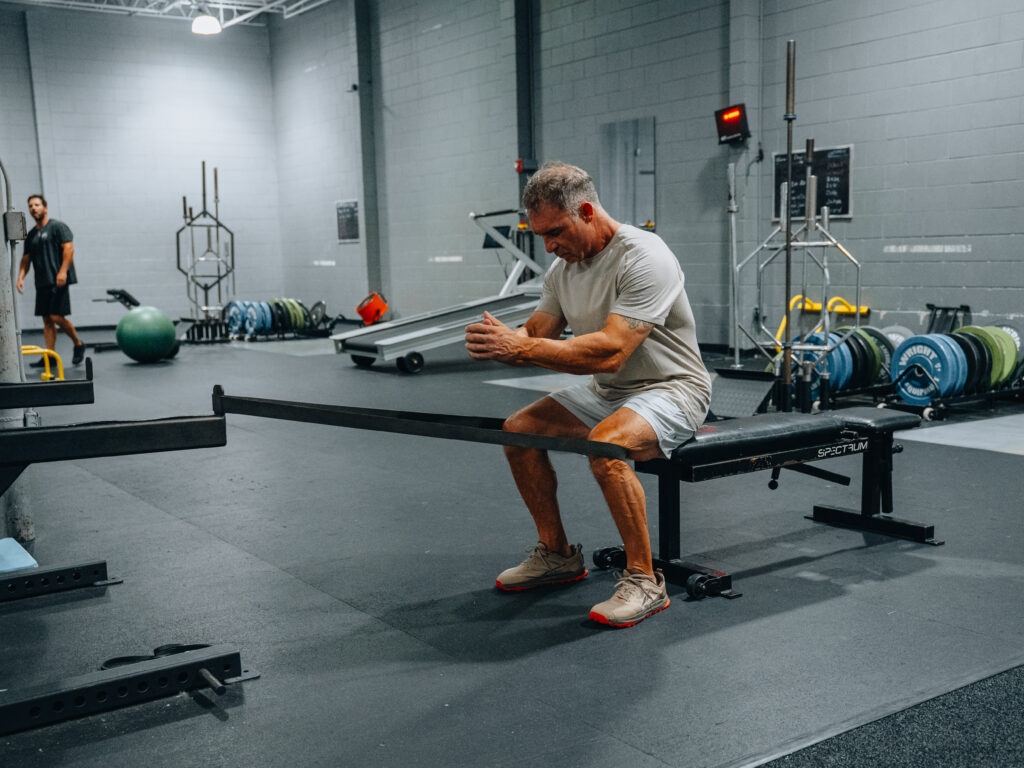
Movement Quality and Longevity: Why How You Move Matters as Much as How Strong You Are
When people think about fitness and longevity, the conversation often centers around strength, cardiovascular health, body composition, and maintaining muscle mass as we age. All are important components of long-term health.
But there’s another piece of the equation that doesn’t always receive the same attention: movement quality.
How well you move influences how you train, how you recover, and how confidently you navigate everyday life. From getting up off the floor to carrying groceries, climbing stairs, playing golf, or keeping up with your kids and grandkids, movement is the foundation of physical independence.
At SPECTRUM, we believe fitness should do more than improve your performance inside the gym. It should improve your ability to live outside of it.
And that starts with moving well.
What Is Movement Quality?
Movement quality refers to your ability to perform movements with appropriate mobility, stability, coordination, and control.
It’s not about achieving perfect technique or moving exactly like someone else. Everyone has different anatomy, injury histories, physical capabilities, and movement strategies.
Instead, quality movement means being able to accomplish a task efficiently, comfortably, and with enough control to manage the demands placed on your body.
Consider a basic squat.
A squat isn’t just an exercise performed in the gym. It’s a movement pattern we use throughout life—sitting down, standing up, picking something off the ground, or lowering ourselves into a chair.
Performing that movement requires several physical qualities working together:
- Mobility: Having enough available motion at the ankles, knees, and hips.
- Stability: Controlling the body and joints throughout the movement.
- Strength: Producing enough force to lower and raise the body.
- Coordination: Organizing these qualities into one controlled movement.
When one of these components is limited, the body may adapt by finding another way to accomplish the task.
Compensation isn’t automatically bad. The human body is incredibly adaptable. But when movement options become limited, certain activities may become more difficult or place greater demands on other areas.
The goal of training is to improve your available movement options and your ability to use them.
Mobility and Stability: You Need Both
One of the most common misconceptions in fitness is that better movement simply requires more stretching.
Mobility is important, but increasing range of motion doesn’t automatically improve how well someone controls that range.
For example, someone may have enough hip mobility to perform a deep squat but lack the strength or stability to maintain control throughout the movement.
Similarly, a person may have adequate shoulder mobility but struggle to stabilize the shoulder blade during overhead movements.
This is where mobility and stability need to work together.
Mobility gives you access to movement. Stability allows you to control it.
For many adults, the answer isn’t necessarily more stretching. It’s developing strength and control within the ranges of motion they already possess.
Exercises such as split squats, single-leg Romanian deadlifts, carries, step-ups, and controlled rotational movements can improve strength while challenging stability and coordination.
Rather than isolating every physical quality, effective training can develop several simultaneously.
This is particularly valuable as we age because everyday life rarely requires just one quality at a time.
Strength Is Essential, but Movement Matters
Strength training is one of the most important tools we have for supporting long-term physical function.
Maintaining muscle mass and strength helps preserve the ability to perform daily activities, manage physical demands, and remain independent.
But strength alone doesn’t tell the entire story.
An individual may be able to lift a substantial amount of weight on a machine but struggle with balance, coordination, or getting down to and up from the floor.
Another person may have good flexibility but lack the strength to control their body through a movement.
This is why we believe a comprehensive fitness program should include more than traditional resistance training.
It should challenge the body through fundamental movement patterns:
- Squatting and hinging
- Pushing and pulling
- Lunging and stepping
- Carrying and rotating
- Balancing and moving in multiple directions
These patterns develop strength while reinforcing the coordination and control needed for real-world activities.
The objective isn’t simply to become stronger in an exercise.
It’s to become more capable in life.
Balance and Coordination Become Increasingly Important
As we age, changes in strength, reaction time, sensory function, and coordination can affect our ability to maintain balance and respond to unexpected situations.
Think about stepping off an uneven curb, catching yourself after a stumble, or navigating an unfamiliar hiking trail.
These situations require the body to recognize a change, organize a response, and produce enough force to maintain or regain control.
Balance is not just the ability to stand on one foot.
It’s the ability to control your center of mass while moving, changing positions, and responding to the environment.
Fortunately, balance and coordination can be challenged and improved through appropriate training.
Single-leg exercises, multidirectional stepping, loaded carries, and controlled changes of direction can all contribute.
For older adults, appropriately progressed balance and functional exercise programs are also supported by research for reducing fall risk.
Importantly, these exercises don’t have to be complicated.
A well-executed step-up or split squat can provide significant value when matched to the individual’s ability.
Consistency and progression matter more than novelty.
Movement Variety Builds Physical Capacity
Modern life encourages us to spend significant time in relatively few positions.
We sit at desks, drive cars, look at screens, and repeat many of the same movements throughout the day.
Over time, this can mean certain movement patterns receive very little exposure.
Training provides an opportunity to reintroduce movement variety in a structured environment.
We can move forward, backward, laterally, and rotationally. We can challenge different joint positions, loading patterns, and speeds.
This variety helps develop a broader range of physical capabilities.
For example, traditional strength exercises often emphasize movements in the sagittal plane—forward and backward.
But everyday life also requires lateral and rotational movement.
Reaching into the back seat of a car, turning to pick something up, stepping sideways around an obstacle, or swinging a golf club all involve movement outside a straight line.
Including exercises such as lateral lunges, rotational medicine ball movements, and multidirectional stepping helps prepare the body for these demands.
The objective isn’t to make every workout complicated.
It’s to avoid becoming strong in only a narrow range of movements.
Movement Quality Can Help Support Injury Reduction
No exercise program can eliminate the possibility of injury.
However, improving strength, movement control, and physical capacity can help prepare the body for the demands it encounters.
Many injuries and physical setbacks occur when the demands placed on the body exceed its current capacity.
Sometimes that involves too much load, too much volume, insufficient recovery, or a sudden increase in activity.
Other times, limited strength or movement options may contribute to the problem.
This is why we focus on building capacity rather than simply avoiding movements that feel challenging.
If someone struggles with a particular exercise, the answer isn’t always to eliminate that movement permanently.
We can modify the load, range of motion, speed, or complexity and gradually progress as their capabilities improve.
A person who cannot comfortably perform a full squat might begin with a box squat.
Someone who struggles with single-leg balance might start with supported split squats.
A person returning from an injury might initially use a reduced range of motion before progressively rebuilding strength.
The goal is to create progressions that allow people to continue developing rather than constantly working around limitations.
Good training should expand what your body is capable of doing—not continually reduce your options.
Movement Quality Changes With Age, but Improvement Is Still Possible
One of the biggest mistakes adults make is accepting declining physical capabilities as an unavoidable part of aging.
Yes, the body changes over time.
Muscle mass, strength, power, and certain aspects of movement function can decline with age, particularly when physical activity decreases.
But age alone doesn’t determine what someone is capable of.
An appropriately designed training program can improve strength, balance, coordination, and physical function well into later life.
The key is understanding where someone is starting and progressing accordingly.
A 35-year-old recreational athlete, a 55-year-old golfer, and a 75-year-old adult looking to maintain independence may have different goals and training needs.
But the underlying principles remain remarkably similar.
Build strength.
Maintain useful mobility.
Develop stability and control.
Challenge balance and coordination.
Continue exposing the body to appropriate physical demands.
The exercises, loads, and progressions may look different, but the objective remains the same: maintaining the ability to move confidently and independently.
Train for the Life You Want to Live
One of the questions we encourage adults to consider is simple:
What do you want to continue doing 10, 20, or 30 years from now?
Maybe it’s playing tennis or golf.
Maybe it’s traveling, hiking, cycling, or skiing.
Maybe it’s being able to pick up your grandchildren, work in the yard, or get up off the floor without assistance.
These activities all require some combination of strength, mobility, stability, balance, and coordination.
A well-designed fitness program should help preserve and improve those qualities.
At SPECTRUM, our approach to adult fitness emphasizes strength training, movement development, and progressive physical challenges tailored to the individual.
We want people to become stronger, but we also want them to move confidently, maintain physical independence, and continue participating in the activities that make life enjoyable.
That means paying attention not only to how much weight someone lifts, but also to how they move, what they can control, and how their physical capabilities are changing over time.
Because fitness isn’t simply about what you can accomplish during a workout.
It’s about what your workouts allow you to accomplish everywhere else.
The Bottom Line
Movement quality and longevity are closely connected.
Maintaining strength is essential, but so is preserving the ability to move through different positions, control your body, maintain balance, and respond to the physical demands of everyday life.
The goal isn’t perfect movement.
It’s maintaining the strength, confidence, and physical capacity to keep doing the things you enjoy.
Don’t just train to get stronger today. Train to keep moving well for years to come.
Leave a Reply