



Change of Direction Mechanics and Deceleration Science: Why Slowing Down Is the Key to Moving Faster
Speed gets attention.
Athletes want to sprint faster. Coaches want more explosive players. Parents want to see improvements in acceleration and top-end speed.
But in most field and court sports, athletes rarely get to run in a straight line for very long.
Soccer players cut to create space. Basketball players stop and change direction to defend. Football players plant and redirect. Lacrosse players accelerate, decelerate, and reaccelerate constantly.
The ability to change direction efficiently can be just as important as the ability to sprint fast.
And one of the biggest factors determining how quickly an athlete can change direction is something that receives far less attention:
The ability to slow down.
Effective change of direction begins with effective deceleration.
What Is Change of Direction?
Change of direction, or COD, is the ability to intentionally reduce momentum, reposition the body, and accelerate in a new direction.
It is important to distinguish change of direction from agility.
Change of direction involves a predetermined movement. The athlete knows where they are going before the movement begins.
Agility includes a perceptual and decision-making component. The athlete must react to an opponent, ball, coach, or other external stimulus before changing direction.
A 5-10-5 shuttle is a change-of-direction test.
A defender reacting to an attacking player is agility.
The physical qualities required to execute the cut may be similar, but true agility adds another layer: read, react, and then move.
Before athletes can become highly agile, they need the physical ability to control their bodies when changing direction.
You Can’t Change Direction Until You Stop Going the Other Way
This sounds simple, but it is one of the most important concepts in change-of-direction training.
Imagine an athlete sprinting forward who suddenly needs to cut 90 degrees to the right.
The athlete cannot immediately produce maximum force to the right.
First, they must reduce the momentum carrying them forward.
That requires braking.
Once enough forward momentum has been controlled, the athlete can reposition the body, apply force into the ground, and accelerate in the new direction.
Think of change of direction as three connected phases:
BRAKE → PLANT → PROJECT
The quality of each phase affects the next.
Poor braking creates a poor plant.
A poor plant limits the athlete’s ability to produce force.
And poor force application results in slower reacceleration.
The Science of Deceleration
Acceleration is the process of increasing velocity.
Deceleration is the process of decreasing velocity.
From a physical standpoint, slowing down requires the athlete to produce forces that oppose their current direction of travel.
The faster an athlete is moving, the more momentum they must control.
This creates an interesting challenge for fast athletes.
As athletes become faster, their ability to decelerate must improve with them.
Improving sprint speed without developing the strength and movement strategies required to control that speed can create a performance gap.
Building a bigger engine is valuable.
But you also need better brakes.
Why Strength Matters
Deceleration places significant demands on the muscular system.
When an athlete slows down, muscles must produce high levels of force while lengthening. This is known as eccentric muscle action.
The quadriceps, hamstrings, glutes, calves, and other lower-body muscles all contribute to absorbing and controlling force.
This is one reason strength training plays such an important role in change-of-direction ability.
Athletes need sufficient strength to tolerate the forces associated with:
- Sprinting
- Stopping
- Landing
- Cutting
- Reaccelerating
A stronger athlete generally has a greater capacity to absorb force.
But simply being strong isn’t enough.
Athletes must also learn how to apply that strength quickly and in the appropriate direction.
The Braking Phase Starts Before the Final Step
One common coaching mistake is focusing only on the athlete’s plant foot.
Effective deceleration actually begins several steps before the change of direction.
As the athlete approaches the cut, they should begin progressively reducing velocity.
This often involves:
- Shortening stride length
- Increasing step frequency
- Lowering the center of mass
- Increasing braking forces
- Preparing the body for the upcoming plant
The sharper the intended change of direction, the more braking typically needs to occur before the final plant.
A 30-degree directional change requires a very different strategy than a complete 180-degree turn.
Athletes who wait until the final step to slow down often create excessive braking demands on a single plant.
Lower Your Center of Mass
Body position plays an important role in efficient deceleration.
As athletes prepare to change direction, they generally need to lower their center of mass.
This creates a more stable position from which to absorb and redirect force.
Coaches will often use cues such as:
“Sink the hips.”
“Lower into the cut.”
“Stay athletic.”
However, lowering shouldn’t happen only at the final plant.
Athletes should gradually adjust their posture as they approach the change of direction.
The objective is to arrive at the plant in a position that allows them to control momentum and immediately produce force in the new direction.
The Penultimate Step
One of the most important steps in change-of-direction mechanics is often the step immediately before the final plant.
This is called the penultimate step.
The penultimate step can play a major role in reducing momentum and lowering the athlete’s center of mass before the final directional change.
Instead of asking the final plant leg to absorb all of the athlete’s momentum, effective athletes distribute braking across multiple steps.
This allows the final plant to become less about simply stopping and more about redirecting force.
That’s an important distinction.
The goal isn’t just to stop.
The goal is to stop efficiently enough that you can move again immediately.
The Plant Step: Position Matters
Once momentum has been sufficiently controlled, the athlete needs to establish an effective plant position.
Foot placement matters.
Body position matters.
Joint angles matter.
Where the athlete places the foot relative to the body’s center of mass influences how effectively they can create the forces necessary to redirect movement.
But there isn’t one universally perfect cutting position.
The optimal strategy changes depending on:
- Approach speed
- Angle of the cut
- Sport
- Playing surface
- Position
- Opponent location
- The athlete’s individual movement strategy
A shallow cut performed at high speed looks very different from a 180-degree change of direction.
Training should expose athletes to multiple angles and situations rather than teaching one rigid cutting technique.
Reacceleration: Get Out of the Cut
A great deceleration isn’t useful if the athlete can’t accelerate afterward.
Once the plant occurs, the athlete must quickly shift from absorbing force to producing it.
This is where strength, power, body position, and technique come together.
Athletes should aggressively project their center of mass toward the new direction while applying force into the ground.
Good reacceleration typically involves:
- Positive shin angles
- Strong horizontal force production
- Aggressive arm action
- Appropriate forward body lean
- Powerful first steps
The objective is to minimize the time spent transitioning between braking and propulsion.
Elite movers don’t simply stop quickly.
They get out of the cut quickly.
Deceleration Is a Skill
Athletes frequently practice acceleration.
They sprint 10 yards.
They perform resisted starts.
They work on first-step quickness.
But how often do athletes specifically practice stopping?
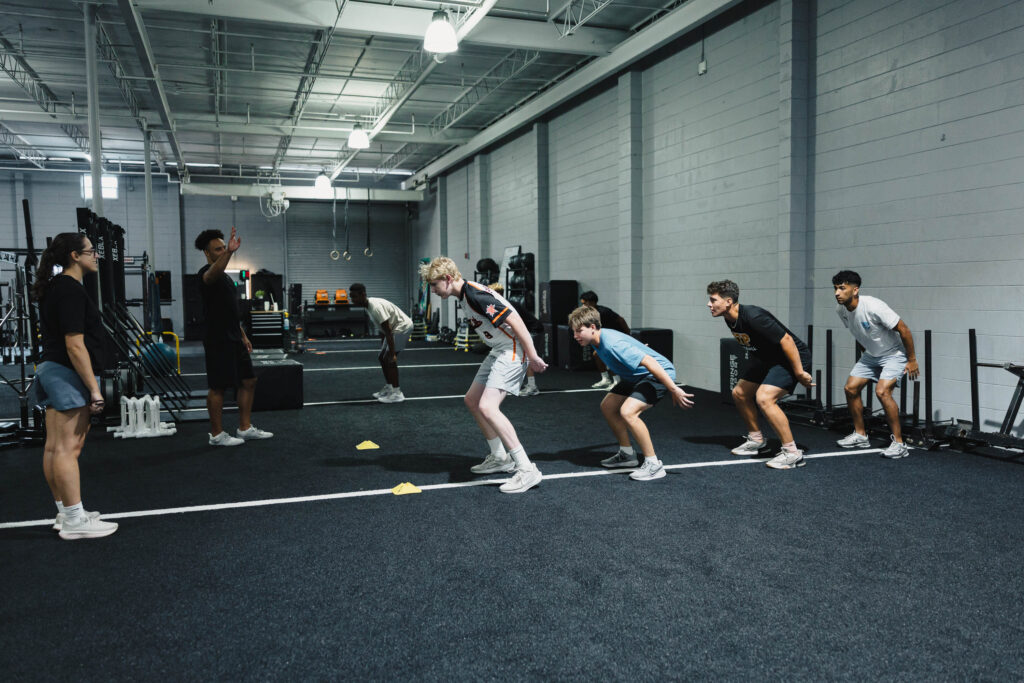
Deceleration should be trained as a skill.
Early progressions can be extremely simple:
Accelerate five yards and stop under control.
Sprint and stick.
Decelerate into an athletic position.
Progressively increase the entry speed.
From there, athletes can progress toward:
- Forward-to-lateral movements
- Lateral-to-forward movements
- 45-degree cuts
- 90-degree cuts
- 180-degree changes of direction
- Reactive change-of-direction drills
The goal is to build braking capacity before exposing athletes to increasingly chaotic movement.
Planned Change of Direction Before Reactive Agility
There is value in cone drills—but only when we understand what they accomplish.
Cone drills allow athletes to rehearse specific movement patterns in a controlled environment.
They can develop:
- Foot placement
- Body position
- Braking mechanics
- Directional force application
- Reacceleration technique
Once those qualities improve, training should become increasingly reactive.
Instead of knowing where to move, athletes may have to respond to:
- A coach’s signal
- Another athlete
- A ball
- A visual cue
- A competitive situation
This progression takes athletes from movement competency to true agility.
Because sport isn’t scripted.
Don’t Confuse Fast Feet With Effective Movement
Another common mistake in agility training is placing too much emphasis on how quickly an athlete can move their feet.
Fast feet can look impressive.
But change of direction isn’t a foot-speed competition.
The athlete must manipulate their entire body mass.
What matters is the athlete’s ability to:
Absorb force → control momentum → reposition the body → produce force in a new direction.
Sometimes the fastest movement involves fewer steps, not more.
Efficiency matters.
Train the Physical Qualities Behind Change of Direction
Technical coaching is only part of the solution.
Athletes also need the physical capacity to execute the movement.
An effective training program should develop:
Eccentric Strength
Athletes must be able to absorb large forces during braking.
Exercises such as split squats, Romanian deadlifts, squats, lunges, and eccentric-focused strength work can help develop this capacity.
Single-Leg Strength
Most cutting and directional changes involve significant force being managed through one leg.
Single-leg training helps prepare athletes for these demands.
Plyometric Ability
Jumping, hopping, bounding, and landing teach athletes to absorb and rapidly reproduce force.
Acceleration
After changing direction, athletes need to regain speed quickly.
Sprint Speed
Faster athletes create more separation and can reach spaces sooner—but remember that increased speed also increases braking demands.
Trunk Control
The torso plays an important role in maintaining balance and controlling body position during aggressive directional changes.
Deceleration Training May Also Play a Role in Injury Reduction
Poor force absorption isn’t only a performance problem.
It may also contribute to injury risk.
High-speed cutting and landing can place significant loads on the knees, ankles, hips, and surrounding tissues.
Teaching athletes to control their center of mass, distribute braking across multiple steps, and develop adequate strength can improve their ability to tolerate these demands.
No training program can eliminate injuries.
But preparing athletes for the forces they will encounter during competition is an important part of building resilient athletes.
Test What Matters
Change-of-direction performance can also be measured.
Tests such as the:
- 5-10-5 shuttle
- 505 test
- Modified agility tests
- Deceleration assessments
can provide useful information about an athlete’s ability to change direction.
But coaches should look beyond the final time.
How did the athlete stop?
Did they require unnecessary steps?
Could they control their body position?
Was there a noticeable difference between directions?
Did they accelerate effectively out of the cut?
The stopwatch tells us what happened.
Movement analysis can help explain why it happened.
Final Thoughts
Speed isn’t just about how quickly an athlete can go.
In many sports, performance depends on how quickly an athlete can go, stop, redirect, and go again.
That’s why change-of-direction training should involve much more than running around cones.
Athletes need sufficient strength to absorb force, proper mechanics to control momentum, effective body positioning to redirect force, and enough power to accelerate into the next movement.
At SPECTRUM Performance, we view deceleration as a foundational athletic skill.
First, athletes learn to produce force.
Then they learn to absorb it.
Finally, they learn to redirect it.
Because sometimes the key to moving faster is first learning how to slow down.
Leave a Reply