



The Science of Speed: What Actually Makes You Faster

Speed is one of the most sought-after qualities in sport — and one of the most misunderstood.
Athletes want to run faster. Coaches want to develop speed. Parents want to help their athletes gain an edge. Yet many training approaches still rely on outdated ideas: more running, more conditioning, more effort.
But speed is not simply about trying harder.
Speed is a product of biomechanics, physics, and neuromuscular efficiency. When you understand what truly creates speed, training becomes more precise, more effective, and far more transferable to sport.
This is the science of speed — and what actually makes an athlete faster.
Speed Is Force Applied in the Right Direction

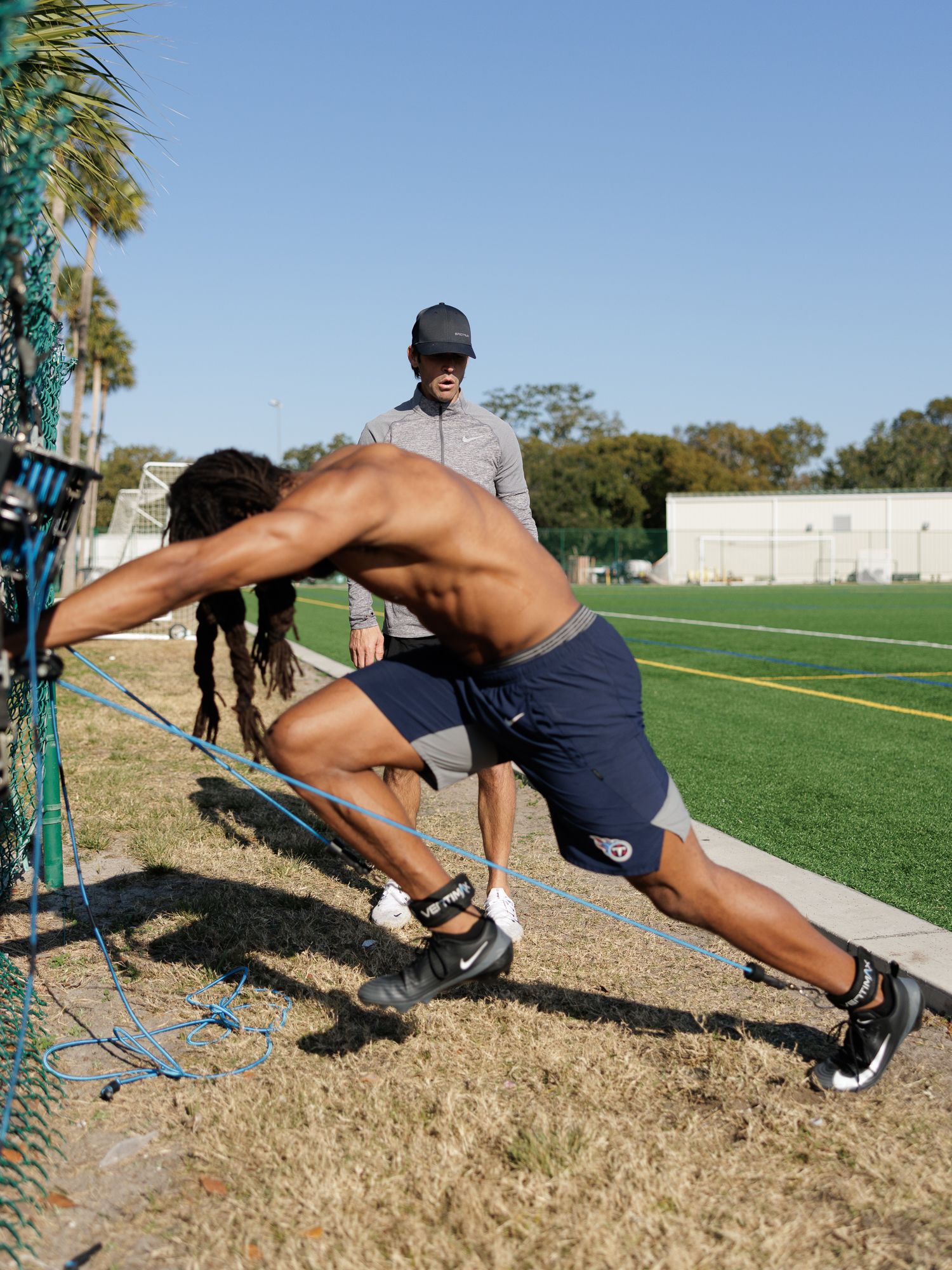
At its most fundamental level, speed is about how much force you can apply into the ground, how quickly you can apply it, and where that force is directed.
Every step in sprinting is a force interaction with the ground. The ground does not move — so the athlete must push against it to move forward.
Faster athletes:
- Produce more force
- Apply force faster
- Direct force more efficiently
This is why sprinting is not just a cardiovascular activity — it is a power and coordination activity.
Relative Force Production Matters More Than Absolute Strength

Being strong helps. But being strong relative to your body weight matters more.
An athlete who can produce high levels of force quickly without excess body mass will accelerate faster, move more efficiently, and maintain speed longer.
This is why elite sprinters and high-level field sport athletes often display:
- High power-to-weight ratios
- Exceptional lower-body strength
- Efficient force transfer through the body
Strength alone does not guarantee speed. Strength that can be expressed rapidly does.
Acceleration vs. Maximum Velocity

Speed is not one quality — it is multiple phases.
Acceleration
Acceleration is the ability to increase velocity from a stationary or slow position. It depends heavily on:
- Horizontal force production
- Body angles and projection
- Rapid force application
Most field and court sports rely heavily on acceleration, not maximum sprint speed.
Maximum Velocity

Maximum velocity occurs when the athlete is upright and cycling their legs rapidly with minimal braking forces.
This phase depends on:
- Elastic energy utilization
- Ground contact stiffness
- Rapid limb recovery
- Efficient mechanics
Training must address both phases, but the physical demands and mechanics are different.
The Role of Sprint Mechanics

Speed is highly technical.
Even small mechanical inefficiencies can reduce force application or increase braking forces, limiting performance.
Key mechanical factors include:
- Posture and alignment
- Shin angle during ground contact
- Foot strike location relative to the center of mass
- Arm action and rhythm
Efficient mechanics allow athletes to apply force where it matters most — backward into the ground — rather than wasting energy vertically or braking forward motion.
Ground Contact Time and Stiffness

Elite sprinters spend very little time on the ground.
Faster athletes are able to:
- Apply large forces quickly
- Maintain stiffness through the ankle and lower leg
- Minimize energy loss during contact
This quality is sometimes described as reactive strength — the ability to absorb force and reapply it rapidly.
Reactive strength is heavily influenced by tendon stiffness, neuromuscular coordination, and elastic energy storage.
The Stretch-Shortening Cycle

One of the most important physiological mechanisms behind speed is the stretch-shortening cycle.
When a muscle-tendon unit is rapidly stretched and then immediately contracts, stored elastic energy enhances force production.
This is what allows athletes to:
- Sprint efficiently
- Jump explosively
- Change direction rapidly
If the transition between stretch and contraction is too slow, stored energy is lost.
Training that improves timing, stiffness, and coordination enhances this cycle — and therefore speed.
Neuromuscular Coordination and Rate of Force Development

Speed is not just muscular — it is neurological.
The nervous system must:
- Recruit motor units rapidly
- Coordinate muscles in precise sequences
- Regulate timing across joints
This is known as rate of force development — how quickly force can be produced.
Athletes who can activate muscle quickly will outperform those who simply have large muscles but slower activation patterns.
This is why explosive training, sprinting itself, and high-velocity movement are essential components of speed development.
Mobility and Range of Motion

Speed requires movement through large ranges of motion at high velocity.
Restrictions in the hips, ankles, or thoracic spine can:
- Limit stride length
- Alter mechanics
- Increase braking forces
- Reduce force application
Mobility does not create speed on its own, but it allows athletes to access the positions necessary to express speed.
Energy System Considerations
Short sprinting efforts rely primarily on the phosphagen system — the body’s fastest energy pathway.
This system supports:
- Maximal power output
- Short duration efforts
- High-intensity bursts
Excessive endurance-based conditioning can interfere with maximal speed development if it reduces power output or alters muscle fiber characteristics.
Speed training should prioritize quality, full recovery, and maximal intent.
What Does NOT Directly Make You Faster

Many common training approaches have limited transfer to true sprint speed when used alone:
- Excessive long-distance running
- Random conditioning circuits
- Speed ladders without mechanical focus
- High fatigue sprinting
These methods may improve general fitness, but speed development requires precision and specificity.
How Speed Is Actually Developed

Effective speed training targets the key scientific drivers:
- Strength and force production
- Rate of force development
- Sprint mechanics
- Elastic and reactive qualities
- Mobility and movement access
- Technical skill under high velocity
Speed improves when these components are trained intentionally and progressively.
Final Thoughts
Speed is not random. It is not purely genetic. And it is not built through effort alone.
Speed is the result of force, mechanics, coordination, and timing working together.
Athletes become faster when they learn to apply force efficiently, move with precision, and express power rapidly.
That is the science of speed.
And when training reflects that science, performance follows.
Leave a Reply