



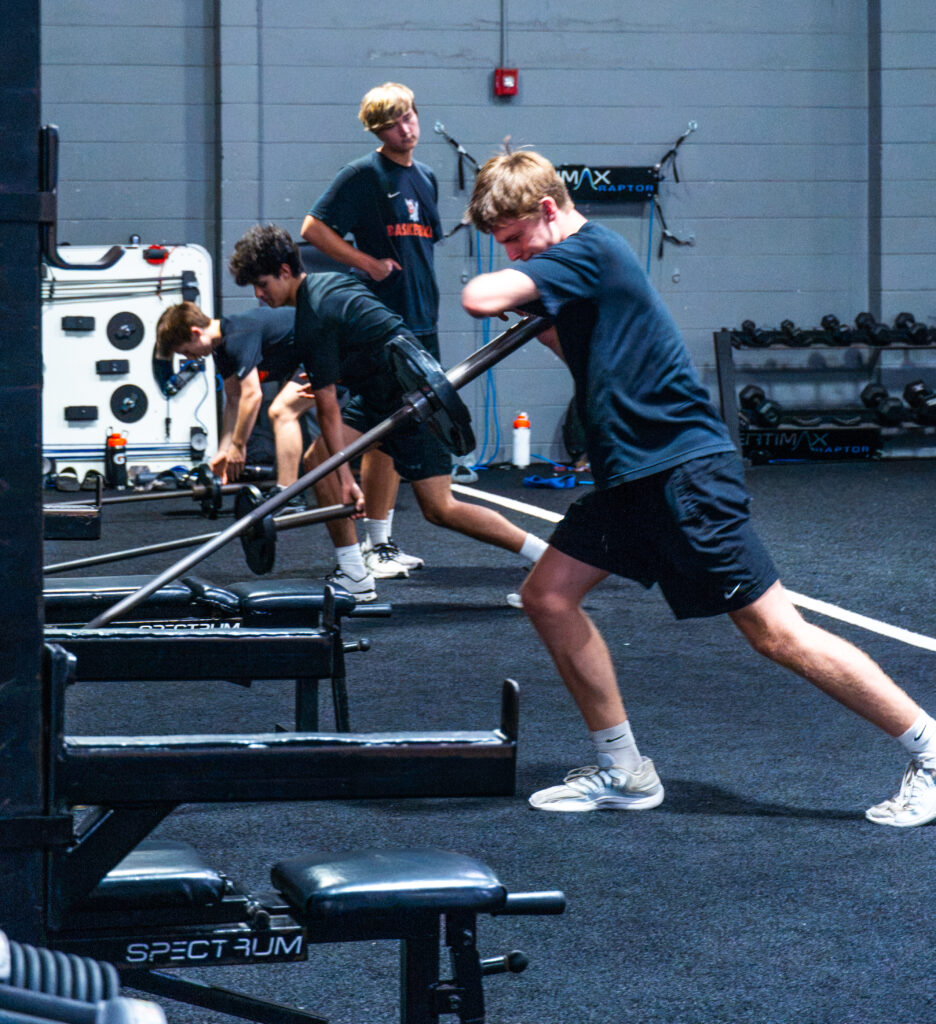
Power Development Without Beating Up the Body
Power matters in nearly every sport.
It is what allows an athlete to accelerate quickly, jump higher, change direction explosively, throw harder, and create separation from an opponent. But developing power does not require athletes to leave every training session exhausted, sore, or physically beaten up.
In fact, when power training consistently creates excessive fatigue, we may be defeating the purpose.
Power is about producing force quickly. That requires speed, intent, coordination, and a nervous system that is prepared to perform. The goal isn’t to see how much work an athlete can survive. The goal is to create high-quality explosive efforts—and provide enough recovery to keep those efforts explosive.
Especially during long competitive seasons, the ability to develop and maintain power without adding unnecessary stress becomes an important part of intelligent sports performance programming.
Power Is About Quality, Not Fatigue
One of the biggest mistakes in power training is treating it like conditioning.
An athlete performs a great jump on rep one. Another good jump on rep two. By rep eight, jump height has dropped, ground contact has slowed, and movement quality has changed.
At that point, are we still training power?
Probably not.
Power development requires high intent and high movement velocity. Once fatigue significantly changes those qualities, the training stimulus has changed as well.
This is why effective power training often involves fewer repetitions than athletes expect.
Three great jumps with full intent can provide a better power stimulus than 15 progressively slower jumps. The same principle applies to medicine ball throws, Olympic lift variations, resisted movements, and sprinting.
More isn’t automatically better.
Better is better.
Use the Right Tool for the Goal
There are many ways to develop power, and no single exercise owns the category.
At SPECTRUM, power development can include:
- Jumps, hops, and bounds
- Medicine ball throws
- Olympic lifts and their variations
- Sprinting and acceleration
- Resisted or assisted movements
- Loaded jumps
- Plyometric progressions
Each provides a slightly different stimulus.
Olympic lift variations allow athletes to produce force rapidly against an external load. Medicine balls allow athletes to accelerate through an entire movement and release the implement. Plyometrics develop the ability to rapidly absorb and redirect force. Sprinting develops explosive force application in one of the most sport-specific expressions possible.
The key is selecting the appropriate tool for the athlete, training phase, and demands of the sport.
Power training doesn’t have to look impressive to be effective.
Extensive vs. Intensive Plyometrics
Plyometric training is a great example of why dose matters.
Not every jump needs to be a maximal box jump or high-intensity depth jump.
Extensive plyometrics use relatively lower-intensity movements performed with rhythm, coordination, and repeated contacts. These can include lower-amplitude pogo variations, skips, hops, and controlled jumping patterns.
They can help athletes develop stiffness, rhythm, coordination, landing mechanics, and elastic qualities without creating the same physical stress associated with more intensive movements.
Intensive plyometrics sit on the other end of the spectrum. These involve greater forces and maximal intent—maximal jumps, bounds, depth jumps, and other highly explosive movements.
Both have value.
The mistake is assuming that because intensive exercises create greater forces, they should make up the majority of the program.
Athletes only have so much high-intensity work available to them. Sprinting, jumping, cutting, practice, and competition all contribute to that total.
Good programming considers the entire workload, not simply what happens inside the weight room.
Develop Power in Multiple Directions
Sport rarely happens exclusively up and down.
Athletes accelerate horizontally, jump vertically, cut laterally, rotate, and combine those movements constantly.
Power development should reflect that.
Vertical power is important for jumping and general lower-body explosiveness. Horizontal power plays a significant role in acceleration. Rotational power is critical in throwing, striking, swinging, and many change-of-direction actions.
Medicine balls are particularly useful here because they allow athletes to train explosive movement in multiple planes with relatively low external loads.
A rotational medicine ball throw, for example, can teach an athlete to produce force from the ground, transfer it through the hips and trunk, and express it through the upper body—all at high velocity.
Because the ball is released, the athlete can continue accelerating throughout the movement rather than having to slow the implement down at the end.
That makes medicine ball training a simple and effective way to accumulate quality power work without excessive loading.
Strength Creates the Foundation
Trying to develop power without adequate strength is like trying to build speed without an engine.
Strength establishes an athlete’s ability to produce force. Power determines how quickly that force can be expressed.
This is why strength and power shouldn’t be viewed as competing qualities.
Squats, deadlift variations, split squats, presses, pulls, and other strength exercises help build the force-producing capacity that supports explosive movement.
But we don’t have to maximize strength work every day.
As athletes move closer to competition—or accumulate greater sport demands—we can reduce training volume while continuing to expose them to enough load to maintain strength.
That leaves more resources available for high-velocity work.
The goal is not to eliminate strength training. It is to find the minimum effective dose that allows us to maintain or improve the qualities we need without creating unnecessary fatigue.
Power Training During the Season
This becomes particularly important once competition begins.
An athlete’s body doesn’t differentiate between stress from practice, games, sprint training, lifting, or jumping. It all contributes to the overall workload.
If an athlete has three games in a week, adding a large volume of maximal plyometrics and heavy lifting probably isn’t the answer.
Instead, power work can become very targeted.
A few high-quality jumps.
A handful of medicine ball throws.
A small number of explosive Olympic lift variations.
Short, high-quality sprint exposures.
Enough to remind the nervous system to move fast without creating fatigue that carries into practice or competition.
During the offseason, we may have the opportunity to build power more aggressively. During the season, the goal often becomes maintaining and expressing it.
The exercise doesn’t necessarily need to change. The dose does.
Know When to Stop
One of the most valuable skills a performance coach can develop is recognizing when the desired training quality is disappearing.
If jump height is dropping, sprint times are getting slower, ground contacts are becoming longer, or technique is deteriorating, adding more repetitions may not improve the session.
Technology can help us objectively monitor this through sprint timing, jump testing, velocity-based training, and other performance metrics.
But coaches also need to watch the athlete.
How are they moving?
Are they explosive?
Are they attacking each repetition?
Has the quality changed?
Sometimes the best decision is to end an exercise while the athlete is still performing well.
That isn’t doing less.
That’s understanding the purpose of the training.
Train Power Without Paying for It Tomorrow
Athletes don’t get better simply because training is difficult.
They get better because training provides the right stimulus, at the right time, in the right amount—and they are able to recover and adapt from it.
Power development is a perfect example.
We want athletes moving fast. Jumping explosively. Producing force quickly. Absorbing force efficiently. And expressing those qualities when their sport demands them.
That requires intensity.
It doesn’t always require volume.
At SPECTRUM, our goal is not to see how tired we can make an athlete. It is to determine what physical qualities they need and provide enough of the right training stimulus to improve them.
Because the best power program isn’t the one that looks hardest on paper.
It’s the one that helps the athlete become more explosive—and still leaves them ready to perform.
Leave a Reply